
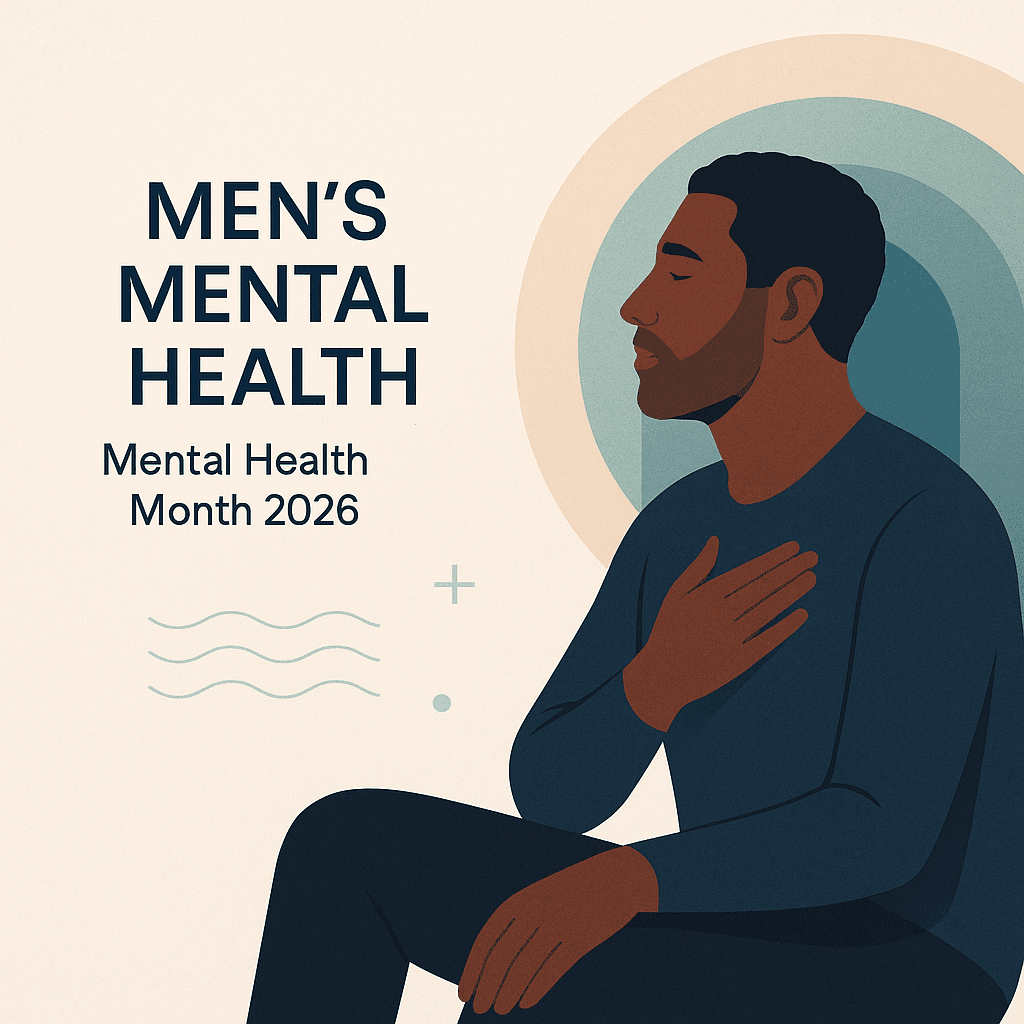
 National Mental Health Month in 2026 feels different, and honestly, it needs to. For a long time, men’s mental health has been sitting in a strange place: widely discussed in theory, but quietly neglected in practice.
A lot of guys are doing “fine” on paper. They show up to work, keep the lights on, handle responsibilities, push through. But under the surface, many are carrying anxiety, depression, trauma, grief, or addiction in a way that never gets named out loud. Not because they do not feel it, but because they do not have a clear place to put it.
This year’s focus matters because men are still more likely to suffer in silence, less likely to seek care early, and more likely to wait until things break. If you are reading this and thinking, “That sounds familiar,” you are not alone. And you are not weak. You are human.
Why this focus is happening now
There are a few reasons men’s mental health is getting more attention in 2026, and none of them are trendy or shallow. They are practical.
First, the conversation around mental health has matured. We are finally moving past basic awareness and into action. People want real tools like building mental strength, real treatment for issues such as addiction and mental illness, and real outcomes.
Second, the last several years have put men under a particular kind of pressure: economic uncertainty, social isolation, rapid cultural change, relationship strain, and a steady stream of “keep grinding” messages. When stress stays high and support stays low, mental health takes the hit.
Third, there is a growing recognition that men often show mental health symptoms differently. Many guys do not present as “sad.” They present as angry, numb, restless, reactive, withdrawn, compulsive, or overworked. If we only look for one stereotype of depression or anxiety, we miss what is right in front of us.
The quiet crisis: why men often do not ask for help
Most men are not taught to say, “I’m not okay.” They are taught to manage. Perform. Provide. Handle it. Keep it moving.
That wiring starts early:
- “Do not cry.”
- “Man up.”
- “Be tough.”
- “Stop complaining.”
- “Deal with it.”
Even when a guy wants help, he may not have the language. Or he may worry about how it affects his job, his family, his reputation, his role as a partner or father. Some men fear being seen as a burden. Others have been burned before by opening up and getting dismissed or mocked.
If any of that rings true, one small step that can help is a private, no-pressure conversation with a professional team that understands men’s mental health and addiction as they actually show up in real life. If you want to talk through what you have been carrying, we can help you sort it out at Spirit Mountain Recovery and figure out what level of support makes sense.
What men’s mental health struggles often look like (in the real world)
A lot of men do not recognize their own symptoms because they are expecting a dramatic breakdown. More often, it is a slow grind.
Here are patterns we see again and again:
Irritability and anger that feels “out of character”
You snap faster. You feel on edge. Small things set you off. Then you feel guilty, so you shut down more, and the cycle keeps running.
Numbing out
Not feeling sad does not mean you are okay. Feeling nothing for long stretches can be its own warning sign.
Overworking and staying busy to avoid quiet
If being alone with your thoughts feels unbearable, you will fill every minute. Work, gym, scrolling, late-night TV, side projects. It looks productive, but it is often avoidance.
Risk-taking and impulsive choices
Spending, gambling, reckless driving, affairs, fights, substances. Sometimes pain looks like self-sabotage. This behavior often aligns with the risk factors of addiction for men, where the impulse to escape from pain leads to destructive choices.
Sleep issues
Trouble falling asleep, waking up at 3 a.m., or sleeping “enough” but never feeling rested. Sleep is one of the clearest mental health indicators in men, and one of the most ignored.
Withdrawal from relationships
You stop texting back. You cancel plans. You say you are fine, but you are not reachable.
Substance use that becomes a coping strategy
A drink to “take the edge off” becomes a nightly routine. Weed becomes the way you eat and sleep. Pills become a way to shut your mind off. The line often gets crossed quietly. These signs are often indicative of deeper issues and could be signs of addiction in men.
Why addiction and men’s mental health are tied together
Many men do not start with addiction. They start with pain they do not know how to process.
Depression, anxiety, PTSD, unresolved grief, shame, chronic stress, and relationship wounds can all create the same question in the mind: “How do I make this stop?”
Substances work quickly. That is the trap. They provide immediate relief, even if the long-term cost is brutal.
That is why treatment that addresses only the substance but ignores the underlying mental health piece often falls short. If you remove the coping tool but keep the pain untouched, the craving will come back, or something else will replace it.
Real recovery for many men means dealing with both sides honestly:
- The behavior (drinking, using, compulsions)
- The reason it became necessary (stress, trauma, depression, anxiety, loneliness)
At Spirit Mountain Recovery we understand that addiction and men’s mental health are intertwined issues that require comprehensive treatment strategies. We take mental health and substance use seriously together because most men do not have the luxury of treating them as separate problems.
The loneliness factor nobody wants to admit
A lot of men are lonely, even when they are surrounded by people.
You can have a wife, kids, co-workers, friends, and still feel like nobody actually knows you. Not the real you. Not what you worry about at night. Not the pressure you feel. Not the resentment you are ashamed of. Not the fear that you might be failing.
Male loneliness is not always the absence of people. It is the absence of safe connection.
And loneliness is not just painful. It is risky. It increases stress, worsens depression, pushes men toward compulsive coping, and makes relapse more likely for those in recovery. This is part of why Men’s Mental Health is a focus in 2026: it is not just about individual suffering. It is about what happens to families, communities, and workplaces when men disconnect.
The “provider” trap and why it can break good men
A lot of men measure their worth by output:
- Money earned
- Problems solved
- People protected
- Tasks completed
- Respect maintained
There is nothing wrong with being dependable. The issue arises when your self-worth depends on never needing anything.
When life hits hard—job loss, injury, divorce, financial stress, legal trouble, a death in the family, a child struggling—many men go straight to self-blame and isolation.
They do not want to be seen as weak. They do not want to scare their family. They do not want to be “one more problem.”
So they carry it alone until the load gets too heavy.
If that is where you are right now, this is your reminder: getting help is not abandoning your role. It is protecting it.
Consider exploring options like equine-assisted therapy which can offer unique benefits for those in recovery from mental health issues or substance abuse. If you’re facing dual challenges such as addiction alongside mental health disorders, dual diagnosis rehab for men could provide the comprehensive support needed. Remember that seeking help doesn’t signify weakness but rather strength in acknowledging one’s struggles and taking steps towards healing.
For more resources on rehab for men, don’t hesitate to reach out and explore the available support systems designed specifically for men facing these challenges.
Moreover, it’s essential to recognize and address the “provider” trap, a common struggle among many men that can lead to feelings of inadequacy and isolation when faced with life’s inevitable challenges.
Why men often wait until crisis
Men tend to seek help later than they should, often after a major consequence:
- A partner threatens to leave
- Work performance collapses
- A DUI or legal issue happens
- A panic attack hits out of nowhere
- A relapse becomes undeniable
- Suicidal thoughts start showing up
Waiting for rock bottom is not strength. It is survival mode.
The better move is earlier support, when you still have options and momentum. If you are noticing warning signs and you want to address them before they get worse, reach out to Spirit Mountain Recovery. Even a short conversation can help you map the next right step.
What healthier masculinity looks like in 2026
This is not about blaming men or trying to change who you are. It is about upgrading the definition of strength. As we look towards the future, we need to consider rethinking masculinity and what it means for mental health.
Healthy masculinity includes:
- Self-control, not suppression
- Discipline, not denial
- Courage to speak, not just to fight
- Responsibility for your healing, not excuses
- Brotherhood and support, not isolation
The strongest men are not the ones who never struggle. They are the ones who face what is real and do something about it.
Practical ways men can protect their mental health this month
You do not need a perfect routine. You need a few reliable anchors.
1) Get honest about your baseline
Ask yourself:
- Am I more irritable than I was six months ago?
- Am I avoiding people I care about?
- Am I using alcohol, weed, porn, gambling, or work to cope?
- Do I feel stuck, numb, or hopeless?
- Am I sleeping like a man who is okay?
If the answers concern you, that is data, not shame.
2) Recognize possible signs of mental health issues
It’s crucial to be aware of potential mental health issues such as bipolar disorder, which can often go unnoticed until they become severe. If you’re experiencing extreme mood swings or other concerning symptoms, it’s important to seek professional help sooner rather than later.
2) Pick one person and tell the truth
Not everything. Just one honest sentence.
Examples:
- “I’ve been carrying more than I’ve admitted.”
- “I’m not doing as well as I look.”
- “I think I might need help.”
The goal is connection, not a dramatic confession.
3) Move your body for your mind, not your image
Men often exercise to look strong. Try doing it to feel stable. Walking, lifting, hiking, jiu-jitsu, yard work, anything that burns stress and brings you back to your body helps.
4) Reduce the numbing behaviors
You do not have to quit everything overnight. Start by noticing what you reach for when you feel stressed, lonely, or overwhelmed.
If you cannot stop, or if stopping makes you anxious, that is a sign you may need support.
5) Get professional help before you are desperate
Therapy, psychiatry, group support, and structured treatment exist for a reason. You do not get bonus points for suffering longer than necessary.
Signs it may be time for structured support
Sometimes self-help is not enough. That is not failure. That is reality.
Consider getting a higher level of care if you notice:
- You cannot cut back on drinking or drug use even when you want to
- Your mood swings are affecting your family or job
- You are hiding how bad things are
- You feel emotionally flat most days
- You are having panic symptoms, intrusive thoughts, or trauma flashbacks
- You have thoughts of self-harm or suicide
- You are functioning, but barely
If any of those are true, it may be time to talk to a team that can assess what is going on and recommend a plan that fits your life. Spirit Mountain Recovery is here when you are ready, whether you need detox support, a structured program, or a clear next step.
If you are the spouse, partner, or friend of a man who is struggling
Loving a man who is not okay can be confusing. He might look fine one day and shut down the next. He might deny there is a problem while clearly suffering. He might get defensive when you bring it up.
A few grounded tips:
- Speak to what you observe, not what you assume. “I’ve noticed you’re drinking more and sleeping less.”
- Avoid diagnosing him in the moment. Focus on impact and concern.
- Pick calm timing, not the middle of an argument.
- Offer options, not ultimatums, unless safety is on the line.
- Protect your own mental health too.
Support is not rescuing. Support is creating a path and encouraging him to take it.
However, there may come a time when he is unwilling to seek help. In such situations, it’s crucial to respect his autonomy while also expressing your concerns and willingness to support him.
What we want men to hear during National Mental Health Month 2026
You are allowed to be a work in progress.
You can be strong and still need help. You can be a leader and still have anxiety. You can love your family and still feel burned out. You can be disciplined and still be dealing with trauma. You can be a good man and still be struggling with addiction.
The goal is not to become someone else. The goal is to come back to yourself, clear-headed, steady, and connected.
If you want help getting there, we are ready to walk with you at Spirit Mountain Recovery.
FAQs (Frequently Asked Questions)
Why is National Mental Health Month in 2026 focusing specifically on men’s mental health?
National Mental Health Month in 2026 highlights men’s mental health because men often suffer in silence, are less likely to seek early care, and frequently wait until issues become severe. The focus addresses practical reasons such as the maturation of mental health conversations, increased pressures on men from economic and social changes, and a growing understanding that men show mental health symptoms differently than stereotypes suggest.
What are some common signs that a man might be struggling with mental health issues even if he seems “fine” on the surface?
Men may exhibit signs like irritability and anger out of character, emotional numbness, overworking to avoid quiet moments, risk-taking or impulsive behaviors, sleep disturbances, withdrawal from relationships, and using substances as coping strategies. These patterns often indicate deeper mental health struggles that may not be immediately obvious.
Why do many men find it difficult to ask for help with their mental health?
Many men are culturally conditioned to manage emotions silently through messages like “man up” or “stop complaining.” They may lack the language to express their feelings or fear negative impacts on their job, family, or reputation. Past experiences of dismissal or mockery can also discourage seeking support.
How do addiction and men’s mental health challenges relate to each other?
Addiction often begins as a way to cope with unprocessed pain such as depression, anxiety, PTSD, or unresolved grief. Substances provide quick relief but don’t address underlying issues. Effective treatment must tackle both addiction and the root mental health problems to prevent relapse and promote real recovery.
What practical steps can men take if they recognize these signs in themselves?
A helpful step is initiating a private, no-pressure conversation with professionals who understand men’s mental health and addiction realities. Services like Spirit Mountain Recovery offer tailored support to sort out what level of care is appropriate and provide tools for building mental strength and addressing co-occurring issues.
How have recent societal pressures contributed to men’s mental health struggles?
Men face unique pressures including economic uncertainty, social isolation, rapid cultural shifts, relationship strain, and persistent messages to “keep grinding.” When stress remains high without adequate support systems, it negatively impacts mental well-being and increases vulnerability to conditions like anxiety and depression.