
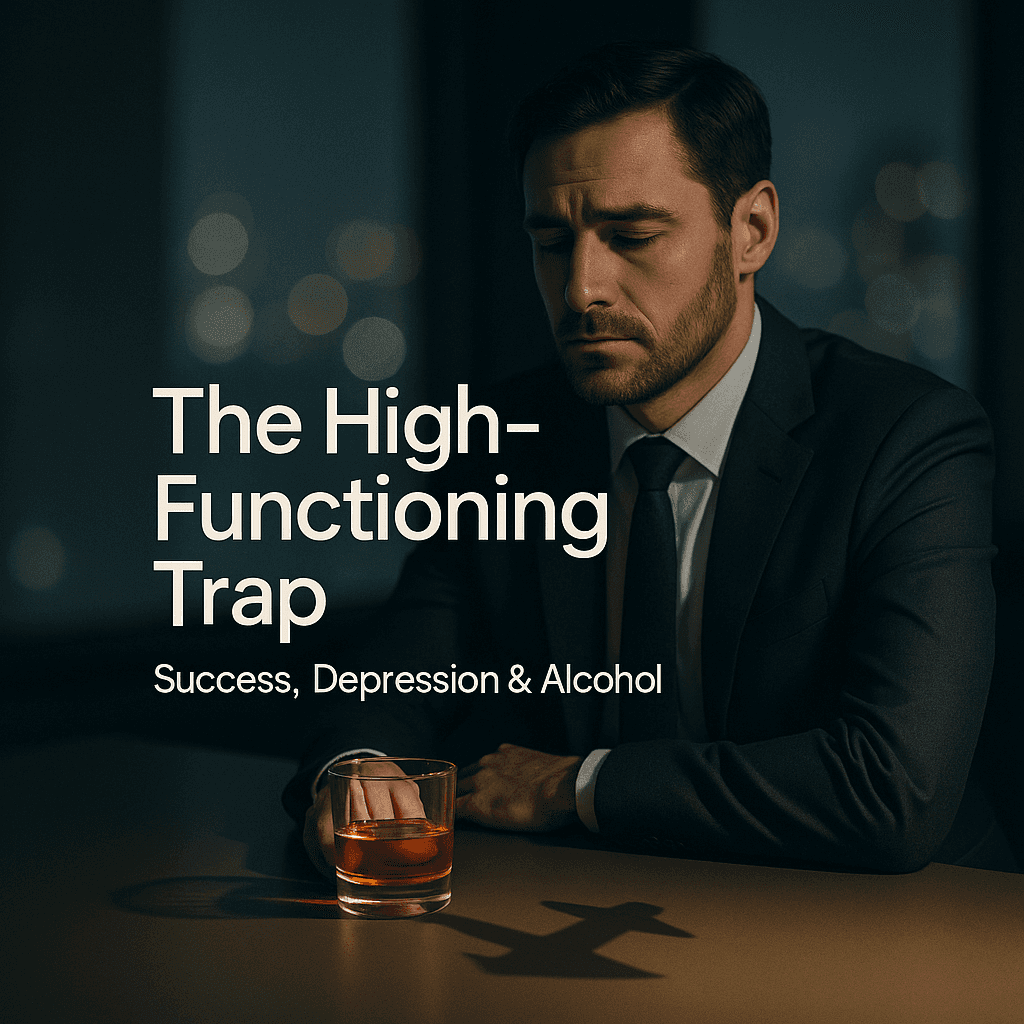
 A lot of men learn early that results matter more than feelings.
You show up. You handle it. You provide. You keep your word. And when life gets heavy, you don’t fall apart, you tighten up. You get more disciplined. More productive. More “fine.”
From the outside, it can look like strength.
From the inside, it can feel like trying to breathe through a straw.
For high-functioning men, depression often does not look like staying in bed for days. It can look like running meetings, coaching the team, paying the mortgage, hitting the gym, and answering texts with “all good” while privately feeling flat, restless, or quietly hopeless. And alcohol can become the most socially acceptable way to manage that gap.
Not to get wasted, necessarily. Just to take the edge off. To shut down the mental noise. To fall asleep. To feel something. To feel nothing.
This is the high-functioning trap: you keep succeeding, so no one worries. Including you.
What “High-Functioning” Depression Often Looks Like in Men
Depression in men is frequently mislabeled, minimized, or missed because it does not always match the stereotype. Many guys do not present as outwardly sad. Instead, it shows up in ways that can pass as personality, stress, or ambition.
Common patterns include:
- Irritability, impatience, or a short fuse, especially at home
- Feeling numb or disconnected, even during “good” moments
- Waking up tired, dragging through the day, then getting a second wind at night
- Restlessness, needing to stay busy, struggling to relax without guilt
- Losing interest in hobbies, sex, or friendships, but still performing at work
- Overthinking, rumination, and harsh self-criticism
- A sense of emptiness that achievement does not fix
- Physical symptoms: headaches, stomach issues, tight chest, chronic tension
A lot of successful men are also skilled at compartmentalizing. They can feel awful internally and still deliver externally. That ability might have helped you build a career but it can also make it easier to miss that something is seriously wrong.
In such cases where high-functioning depression is accompanied by unhealthy coping mechanisms like substance abuse which could lead to addiction as seen in the signs of addiction in men, it’s crucial to seek professional help. Programs such as professional rehab for men or wilderness addiction treatment offered by specialized facilities can provide the necessary support and guidance for recovery.
Why Alcohol Becomes the “Solution” That Doesn’t Look Like a Problem
Alcohol works fast, and it works reliably. At least at first.
It lowers inhibition. It blunts anxiety. It interrupts racing thoughts. It gives a brief sense of relief. For a man who feels pressure to stay composed, that relief can feel like the closest thing to rest.
And it is socially reinforced. Nobody questions a couple drinks after work. Nobody panics when a dad cracks beers on the weekend. Nobody sees the warning signs when the guy who “has it together” is the one always pouring.
Alcohol also fits neatly into a high-functioning lifestyle:
- It’s a quick off-switch after intense days
- It requires no vulnerability
- It avoids “needing help”
- It can be done privately and explained easily
- It feels earned: “I worked hard. I deserve this.”
However, over time, the reason for drinking quietly shifts. It stops being about celebration and starts being about regulation.
Sleep. Mood. Stress. Anger. Loneliness. Numbness.
When alcohol becomes your main tool for regulating your internal world, it can look normal from the outside while the inside slowly erodes. This transition often leads to alcohol abuse, which can have severe consequences on both physical and mental health.
Understanding how alcohol affects the brain is crucial in recognizing these changes. If you’re unsure whether your drinking habits have crossed the line into alcoholism, it’s important to educate yourself on the basics of alcohol addiction.
For some individuals, especially as they age, it’s vital to be aware of certain facts about aging and alcohol which might influence their relationship with alcohol.
If any of this is hitting close to home, it may be worth having a private, pressure-free conversation with us at Spirit Mountain Recovery. You do not need to be in crisis to reach out, and you do not need to “prove” your situation is bad enough.
For those considering making a change, it’s essential to understand what detox from alcohol entails. We are here to provide support and guidance through this process, helping you reclaim control over your life and find healthier ways to cope with stress and emotions.
The Quiet Cost of Always Being the Capable One
High-achieving men often carry a specific kind of loneliness.
Not the kind where you have nobody. The kind where you have people, but you don’t feel known.
You may be the dependable one in your marriage, family, workplace, or friend group. The fixer. The leader. The guy others lean on. That role can become a cage because it does not leave room for you to have needs.
So you adapt:
- You keep conversations surface-level
- You avoid burdening anyone
- You push feelings down until they leak out as anger or withdrawal
- You stay busy so you do not have to sit with yourself
Alcohol becomes the “permission slip” to finally exhale. Or finally feel. Or finally stop feeling.
But the next morning, the weight is still there. Often heavier.
The Masking Cycle: How Depression and Alcohol Reinforce Each Other
This cycle tends to be gradual, which is why smart, successful men can get caught in it without realizing it’s happening.
- Depression creates internal pressure
- You feel low, anxious, numb, restless, or disconnected. You still function, but it costs more.
- Alcohol provides short-term relief
- Your body relaxes. Your thoughts slow down. You feel normal for a moment.
- Alcohol worsens the underlying symptoms
- Sleep quality drops. Mood stability declines. Anxiety rebounds. Motivation dips. Shame increases.
- You compensate by working harder and showing less
- You double down on productivity, discipline, control, and image management.
- You drink again to manage the new stress
- The relief becomes more necessary, and often less effective than it used to be.
This is not a character flaw. It is a predictable outcome when a man is trying to manage depression without support, using a substance that temporarily soothes but ultimately intensifies the problem.
The impact of alcohol on the body can be severe and long-lasting, leading to various health issues that require professional intervention such as alcohol detox. Understanding how alcohol impacts the body is crucial for anyone grappling with its use as a coping mechanism.
It’s important to note that while alcohol might provide temporary relief from emotional pain or stress, it also has long-term effects that can worsen mental health conditions like depression and anxiety. This vicious cycle often leads individuals towards alcohol addiction, making it even more essential to seek help and support in breaking free from this pattern.
Why “I’m Not an Alcoholic” Can Still Be a Warning Sign
Many men avoid getting help because they do not identify with the label “alcoholic.” You might think:
- “I never miss work.”
- “I don’t drink in the morning.”
- “I’m not getting DUIs.”
- “I can stop for a week if I have to.”
- “It’s just a couple drinks.”
However, here’s the harder, more useful question:
What role is alcohol playing in your emotional life?
If alcohol is how you cope with stress, sleep, loneliness, anxiety, or emptiness, the risk is not only about quantity. It is about dependence, narrowing options, and the slow loss of resilience. This is particularly relevant considering the risk factors of addiction for men.
Another question that cuts through denial is:
What happens when you try to stop for 30 days?
Not “can you,” but what happens inside you.
If stopping makes you feel irritable, restless, unable to sleep, socially uncomfortable, or emotionally exposed, that is information. Not shameful information. Useful information.
The Male-Specific Barriers That Keep This Going
A lot of men do not avoid help because they are stubborn. They avoid it because of identity. Some common barriers include:
Pride (that feels like survival)
You may have built your life on being self-sufficient. Admitting you are not okay can feel like tearing down the very thing that has kept you afloat.
Fear of being a burden
Many men would rather suffer quietly than risk “dumping” on their partner, kids, or friends.
These barriers often prevent men from seeking help even when they exhibit signs of bipolar disorder or are more prone to addiction. It’s crucial to recognize these signs and understand that there are rehab resources specifically designed for men, which can provide the necessary support and guidance.
Fear of Losing Respect
There is a real concern that vulnerability will change how people see you, especially in leadership roles.
Confusing Numbness with Strength
If you grew up in an environment where emotions were punished, ignored, or mocked, shutting down can feel normal. You might not even realize you are depressed. You just know you are tired of everything.
The “I Should Be Grateful” Trap
You can have money, success, and a good family, and still be depressed. Gratitude does not cancel pain. But many men invalidate themselves because their life looks good on paper.
What Alcohol Is Often Covering Up (Under the Surface)
Alcohol is rarely the real issue for high-functioning men. It is often the cover.
Under it, we commonly see:
- Unprocessed grief (loss, divorce, death, estrangement)
- Chronic stress and burnout that has become a lifestyle
- Quiet trauma, including childhood emotional neglect
- Shame and self-worth issues masked by achievement
- Identity confusion: “If I stop producing, who am I?”
- Relationship disconnection, even in a stable home
- Anxiety that looks like control, perfectionism, or constant scanning for problems
Drinking can look like the problem, but it is also a message. Something in your system is asking for care.
The Relationship Fallout: When “Functional” Still Hurts People
Many men believe that if they are still providing and performing, their drinking is not affecting anyone.
But emotional absence has a cost.
Your partner may describe it as:
- “You’re here, but you’re not here.”
- “We don’t talk anymore.”
- “I feel like I’m walking on eggshells.”
- “You’re only relaxed after you’ve had a few.”
Your kids might not understand alcohol. They understand energy. They can feel tension, unpredictability, and disconnection. They learn what “normal” looks like by watching you.
And you feel it too: the subtle distance, the guilt, the sense that you are failing at the one thing you care about most.
A man can look functional and still be slowly losing his life on the inside. This chronic stress and burnout often manifest as an addiction to alcohol which serves as a temporary escape from the underlying issues.
Health and Performance: The Things Men Actually Notice First
One reason high-functioning men stay stuck is that emotional symptoms are easy to rationalize. Physical and performance issues are harder to ignore.
Alcohol can impact:
- Sleep architecture (you pass out, but you do not recover)
- Testosterone and sexual function
- Training recovery and body composition
- Blood pressure and heart health
- Focus, memory, and emotional regulation
- Anxiety levels the next day, especially in the morning
- Inflammation and gut health
Many men come to a breaking point not because they “feel sad,” but because they cannot perform the way they used to. Work suffers. Workouts suffer. Patience runs thin. Motivation disappears. The mind feels foggy and heavy.
That is often when the truth becomes harder to avoid.
What Real Strength Looks Like Here
There is a version of strength that is just endurance. You can white-knuckle your way through years of quiet misery and call it discipline.
There is another version of strength that is more honest:
- Naming what is happening
- Getting support before you lose more
- Learning to regulate emotions without a substance
- Rebuilding relationships with actual presence
- Taking your mental health as seriously as your career
You do not have to wait until everything collapses.
If you are reading this and recognizing yourself, consider taking one small step with us at Spirit Mountain Recovery. Even a short call can help you sort out what’s going on and what options make sense, without pressure and without judgment.
What Helps (Beyond Willpower)
If alcohol has become your primary coping tool, “just drink less” is rarely a complete plan. You willpower your way through a few days, then stress hits, sleep breaks, emotions rise, and the old solution returns.
What actually helps tends to be practical and layered:
- A real assessment of alcohol use, mental health symptoms, sleep, and stress load
- Safer stabilization if withdrawal risk is present (many men underestimate this). This is where our alcohol detox program in Utah can provide the necessary support.
- Therapy that fits men, focused on patterns, emotion regulation, stress tolerance, and identity. Equine-assisted therapy is one such method that has shown significant benefits for men in recovery.
- Skill-building, not just insight: how to downshift your nervous system without a drink
- A plan for evenings, weekends, travel, and social pressure
- Honest support, where you do not have to perform
Depression can be treated. Alcohol dependence can be treated. And the combination is more common than most men realize.
A Simple Self-Check You Can Do Tonight
No journaling required. Just a quick inventory:
- When was the last day you felt genuinely at peace without alcohol?
- Do you look forward to drinking more than you look forward to anything else?
- Do you drink to sleep, to calm anger, or to shut off your mind?
- Have you been hiding how much you drink, even slightly?
- If alcohol disappeared for 30 days, what would you have to face?
Your answers do not make you broken. They just clarify what you are dealing with.
And if you want help figuring out what those answers mean in real terms, we can talk at Spirit Mountain Recovery. You can keep it private, ask questions about our alcohol treatment programs, including our unique approach that incorporates equine-assisted therapy, and decide the next step when you are ready.
If you’re concerned about how long it might take to overcome alcohol addiction, we also provide resources and guidance on understanding how long it typically takes to get addicted to alcohol.
The Way Out of the Trap Is Not Losing Everything First
The high-functioning trap convinces you that you are fine because you are still standing.
But you are not meant to merely stand there and endure your own life.
If you have been using alcohol to hold yourself together, it may be time to build something more solid: support, skills, and a path that lets you keep your success without sacrificing your mental health to maintain it.
When you’re ready, we’re here at Spirit Mountain Recovery to help you take that next step with clarity and respect.
FAQs (Frequently Asked Questions)
What does high-functioning depression in men typically look like?
High-functioning depression in men often doesn’t match the stereotype of sadness or withdrawal. Instead, it can manifest as irritability, numbness, restlessness, loss of interest in hobbies or relationships, overthinking, harsh self-criticism, and physical symptoms like headaches or chronic tension. Men may continue to perform well at work and maintain responsibilities while feeling internally disconnected or hopeless.
Why is high-functioning depression in men often missed or mislabeled?
Because men with high-functioning depression can continue to show up, handle responsibilities, and appear successful externally, their symptoms are often mistaken for personality traits, stress, or ambition. Their ability to compartmentalize feelings allows them to deliver results while struggling internally, making it harder for others and themselves to recognize the severity of their condition.
How does alcohol become a coping mechanism for men with high-functioning depression?
Alcohol provides quick relief by lowering inhibition, blunting anxiety, interrupting racing thoughts, and offering a brief sense of rest. For men feeling pressure to stay composed, drinking can feel like an earned break that requires no vulnerability and fits into a busy lifestyle. Over time, however, alcohol shifts from celebration to a tool for regulating mood, sleep, stress, anger, loneliness, or numbness.
What are the risks of relying on alcohol to manage symptoms of high-functioning depression?
Using alcohol as a primary way to regulate internal struggles can lead to alcohol abuse and addiction. This gradual shift can erode mental and physical health while remaining hidden from others due to the individual’s outward success. Understanding how alcohol affects the brain and recognizing signs of alcoholism are crucial steps toward seeking help before severe consequences occur.
When should men experiencing high-functioning depression and unhealthy coping mechanisms seek professional help?
If unhealthy coping mechanisms like substance abuse begin interfering with daily life or if there’s a growing reliance on alcohol to manage emotions and stress, it’s important to seek professional support. Specialized programs such as professional rehab for men or wilderness addiction treatment offer tailored guidance for recovery and addressing both depression and addiction effectively.
What resources are available for men struggling with high-functioning depression and alcohol use?
Men can access various resources including mental health professionals knowledgeable about male depression patterns, specialized rehab centers focusing on men’s needs like Spirit Mountain Recovery’s professional rehab programs, wilderness addiction treatment options, educational materials on alcohol addiction basics and effects on the brain, and confidential support conversations without needing to be in crisis.