
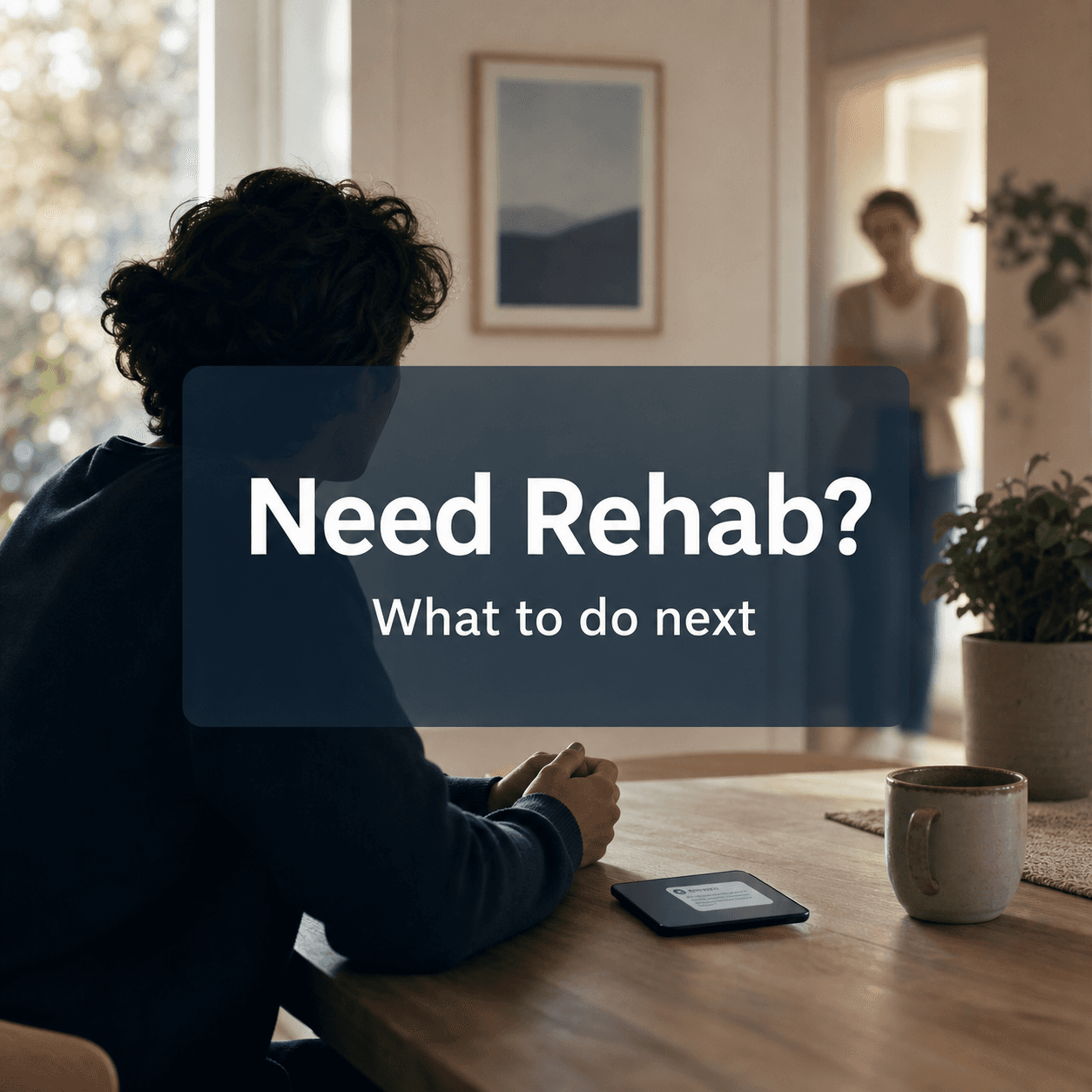
 Hearing “you need rehab” from your wife can land like a punch to the chest.
Part of you might think she is overreacting. Another part might feel ashamed, angry, or cornered. You might also feel a quieter thing under all that: relief that someone finally said out loud what you have been trying not to look at.
Either way, this moment matters. Not because you have to agree with her immediately, but because it is a signal that your drinking or drug use is affecting more than just you. When a partner reaches the point of saying “rehab,” it usually means the situation has become scary, unpredictable, or painfully lonely for them.
If you are asking what to do next, here is a grounded path forward that does not require you to have everything figured out today.
First, slow it down and get specific
“Rehab” is a loaded word. People use it to mean everything from detox to inpatient to outpatient therapy. If you argue about the word, you will miss the message.
Instead, try to get clear on what she is actually seeing.
Pick a calm time, and ask questions like:
- “What happened that made you say rehab now?”
- “What are you most afraid will happen if nothing changes?”
- “What have you noticed getting worse over the last few months?”
- “What would ‘better’ look like to you?”
Then listen without building your defense. You do not have to agree with every detail. Just aim to understand the pattern she is living with.
A simple line that can change the tone is:
“I’m not promising anything yet, but I’m willing to take this seriously and look at options.”
That is not surrender. It is leadership.
As part of exploring options, consider the various approaches available in rehab today. For instance, adventure therapy has shown promising results for many individuals struggling with substance use. This type of therapy often includes outdoor adventure rehab fishing trips, which not only provide a break from the usual environment but also come with significant psychological benefits.
Another option could be wilderness therapy, which has been effective for many in addressing deep-seated issues related to addiction. Whatever path you choose, remember that seeking help is a sign of strength and leadership.
Check your own reality, not your best intentions
Most men I talk to are not trying to destroy their lives. They are trying to cope, sleep, shut their brain off, or get through the day. The problem is that intention does not cancel impact.
A quick self-check:
- Have you tried to cut back and failed?
- Do you hide how much you use, or lie by omission?
- Have you had morning use, blackouts, or “I don’t remember” nights?
- Have you driven when you should not have?
- Has your mood become unpredictable, flat, or short-tempered?
- Are you less present with your kids, your work, your wife, or your own life?
- Do you feel normal only after you use?
If any of those hit close to home, it does not mean you are a bad man. It means the situation is bigger than willpower.
One practical move that helps is writing down the last 30 days. Not a moral confession. Just facts: what you used, how much, what it cost, what it led to, and how you felt the next day. Patterns show up fast when you stop relying on memory.
Don’t let pride turn this into a power struggle
When a spouse suggests that you need rehab, it can trigger a familiar reflex: “You can’t tell me what to do.”
That reflex is understandable. But it can also be the addiction protecting itself by turning the conversation into a control issue instead of a health issue.
Try reframing it like this:
- This is not about being bossed around.
- This is about whether your life is getting smaller.
- This is about whether your home feels safe and steady.
- This is about whether you are still in the driver’s seat.
If your wife is scared, she may come in hot. If you are defensive, you may go cold. That combination turns into distance fast.
You do not have to be perfect here. But you can choose to be grounded.
If you’re struggling with substances like alcohol or Xanax, consider exploring options for alcohol detox or Xanax detox. It’s important to remember that seeking help for addiction is a sign of strength.
Rule out the most dangerous piece first: withdrawal
If you are drinking heavily every day or using certain substances consistently, stopping suddenly can be medically risky. Alcohol withdrawal and benzodiazepine withdrawal, in particular, can be dangerous without supervision.
If any of this applies, take it seriously:
- Shakes, sweating, anxiety, nausea when you stop
- Needing a drink or dose to feel “normal”
- A history of seizures
- Hallucinations or extreme agitation when cutting down
- Using alcohol plus benzos or opioids
This is one of the clearest reasons why rehab or a structured program is recommended. It is not about punishment. It is about stabilizing your body safely so you can think clearly again.
If you are unsure what level of care you need, a quick clinical assessment can clarify whether detox, residential treatment, or outpatient support makes the most sense. If you want help sorting that out, you can reach out to us at Spirit Mountain Recovery for a private, no-pressure conversation about what you are using and what the safest next step looks like.
Rehab is not one thing: know your options
A lot of resistance comes from imagining rehab as one extreme scenario. The reality is that treatment is a range of options designed to meet you where you are.
Here is a simple breakdown:
Detox (medical stabilization)
This is short-term support to help you withdraw safely, manage symptoms, and get through the initial crash period with supervision.
Residential Treatment
Following detox, residential treatment provides a structured environment where patients can focus on recovery without external distractions.
Outpatient Support
For those who have completed detox or residential treatment but still need ongoing support, outpatient rehab offers flexibility while maintaining a strong support system.
Dual Diagnosis Rehab for Men
It’s important to note that many individuals struggling with substance abuse also face mental health challenges. Our specialized dual diagnosis rehab for men addresses both issues simultaneously for more effective recovery. Additionally, if you’re dealing with alcohol addiction alongside mental health struggles, our resources on alcohol dual diagnosis could provide valuable insights.
For more resources tailored specifically for men in recovery, visit our comprehensive guide on rehab for men.
Residential or inpatient treatment
You live at the facility for a period of time. This can be helpful if your home environment is chaotic, if relapse risk is high, or if you need to step away from triggers to rebuild structure.
Partial hospitalization (PHP) and intensive outpatient (IOP)
You attend programming many days per week but do not necessarily live on-site. This can work well if you have support at home, strong motivation, and a stable living situation. For instance, our Partial Hospitalization Program (PHP) offers intensive support while allowing you to return home each night. Similarly, our Intensive Outpatient Program (IOP) provides flexibility with a structured schedule that supports recovery.
Outpatient therapy and recovery coaching
For milder cases, or as step-down care after more intensive treatment.
The right question is not “Do I need rehab?” The better question is:
“What level of support gives me the best chance of actually changing this?”
If you think she’s exaggerating, try a real experiment
If you feel confident you do not need treatment, prove it to yourself with a structured experiment, not a vague promise.
Consider a 30-day plan with clear rules:
- Full abstinence for 30 days (not “cutting back”)
- No secret exceptions
- Track sleep, mood, cravings, and relationships daily
- Add support: therapy, recovery meetings, or a structured program
- Tell your wife what you are doing and how you will be accountable
What usually happens is one of two things:
- You do it, and your life improves noticeably. Great. Keep going and build support so it lasts.
- You cannot do it, or you white-knuckle it and feel miserable. That is valuable information. It suggests you need more than grit.
If you want, we can help you map a plan that fits your work and family schedule so this does not turn into another broken promise. Spirit Mountain Recovery can walk you through what a realistic, supportive next month could look like based on your situation.
What to say to your wife right now (even if you’re not ready)
If things are tense, you do not need a perfect speech. You need a steady one.
Here are a few lines that lower the temperature and keep the door open:
- “I hear you. I know this has been hard to live with.”
- “I’m not going to debate this tonight, but I will take steps.”
- “I’ll get an assessment and we’ll look at options.”
- “I want our home to feel safe. I’m willing to do the work.”
If you are worried she will push for a decision immediately, set a short timeline:
- “Give me one week to talk to a professional, get a recommendation, and bring you a plan.”
That shows seriousness without getting trapped in a fight.
Watch for the signs you’re past “handle it myself”
A lot of men wait until they lose something major before they accept help. You do not have to do it that way.
These are strong indicators that getting professional support is the wise move:
- You keep breaking promises to cut back
- You are hiding, minimizing, or getting angry when questioned
- You have used at work or before driving
- Your wife is pulling away emotionally or setting boundaries
- Your kids are noticing, even if they are not saying it
- You are using to manage stress, sleep, or emotional pain daily
- You feel trapped in the cycle: use, regret, repeat
If your wife is using the word “rehab,” she may be nearing her own breaking point. Not as a threat, but as exhaustion. Many partners stop arguing when they are preparing to detach.
This is where understanding the signs you need rehab becomes crucial. Recognizing these signs early can help prevent further damage and facilitate recovery.
This is not about keeping her from leaving. It is about becoming the kind of man you respect in the mirror again. The relationship often benefits when you do that, but your recovery cannot be built on fear alone.
If you’re considering seeking help, remember that professional rehab for men can provide the support and guidance needed for recovery.
Prepare for the practical objections (work, money, time)
The most common reasons men avoid treatment are not denial. They are logistics.
“I can’t miss work.”
You might not be able to miss work for long, but you also might not be able to keep working like this. Many employers have policies and protections for medical leave. Even when that feels uncomfortable, it can be far better than waiting for a workplace incident.
“We can’t afford it.”
Cost matters. But addiction is rarely cheaper long-term. Between substances, missed productivity, health costs, and relationship fallout, the bill often shows up anyway. Exploring coverage and options such as those provided by Spirit Mountain Recovery’s veteran TRICARE insurance rehab coverage, is worth doing before you assume it is impossible.
“I don’t want to be labeled.”
Treatment is healthcare. Getting help is not weakness. It is a decision to stop bleeding on the people you love, including yourself.
If you are unsure what your options are, we can help you sort through levels of care and what they typically cost, including what may be covered by insurance. If you want to keep it discreet, you can contact Spirit Mountain Recovery and ask for an assessment conversation without committing to anything.
How to choose the right rehab or program (what actually matters)
Not all programs are equal, and the “best” one is the one you will actually engage in.
A few things to look for:
- Qualified clinical staff (licensed therapists, medical oversight when needed)
- A clear plan (assessment, goals, progress tracking, relapse prevention)
- Evidence-based approaches (CBT, motivational interviewing, trauma-informed care)
- Family or couples support (if appropriate)
- Aftercare planning (step-down care, alumni, local supports)
- A culture that feels respectful (you do not need to be shamed into change)
Ask direct questions:
- “What does a typical day look like?”
- “How do you handle relapse risk?”
- “What happens after I leave?”
- “How do you involve family without turning it into blame?”
Your wife may want reassurance that this will not be another short-lived reset followed by the same cycle. A good program will help you build a real plan for life after treatment, not just get you through a few clean days.
To ensure you’re choosing the right program, it’s crucial to understand different levels of care in rehab, which can vary significantly depending on individual needs. Furthermore, having qualified clinical staff is essential for successful recovery; thus understanding the rehab staff counseling aspect is vital.
Additionally, many individuals worry about the effectiveness of rehab programs; however, with proper research and guidance from professionals who understand how long rehab lasts, these concerns can be alleviated. Ultimately remember that drug rehab does work
If you decide to go, make it count
If you commit to treatment, go with the mindset that you are not there to “get your wife off your back.”
Go to learn:
- What you are actually medicating with substances
- What triggers your urge to escape or numb out
- How to handle stress without self-destructing
- How to repair trust through consistent behavior, not speeches
- How to build a support system that survives bad days
A solid rehab experience is not about being fixed. It is about being equipped.
And if you are scared, that is normal. Most men are. Courage is not feeling confident. It is taking the next right step while your chest is still tight.
A simple next-step plan for the next 24 to 72 hours
If you want something concrete, do this:
- Have one calm conversation with your wife. Ask what she has observed, and tell her you will take action.
- Do not quit cold turkey if withdrawal could be a risk. Instead, get medical guidance on how to safely taper off your medication.
- Schedule a professional assessment to determine the right level of care. If you want help taking step three, we can assist in quickly clarifying what level of support fits your use history and life responsibilities.
- Pick one accountability support for this week: therapist, recovery group, trusted friend, or a program.
- Remove easy access if possible: clear the house, avoid using buddies, cancel high-risk plans, and protect your sleep.
You do not have to decide your entire future today.
You just have to take the next honest step.
For those who are unsure about how to convince someone to go to rehab, Spirit Mountain Recovery offers resources that can help guide these conversations effectively.
Additionally, maintaining your routine during rehab can significantly impact your recovery journey. Spirit Mountain Recovery provides valuable insights on how to achieve this balance while undergoing treatment.
FAQs (Frequently Asked Questions)
What should I do when my wife says I need rehab?
When your wife suggests rehab, it’s a sign that your substance use is impacting more than just you. Instead of reacting defensively, slow down and have a calm conversation to understand her concerns. Ask specific questions like what made her say rehab now and what she fears if nothing changes. Listen without building a defense and express willingness to seriously explore options. This approach shows leadership and openness to change.
How can I better understand my wife’s perspective about my drinking or drug use?
Pick a calm time to talk and ask questions such as: ‘What happened that made you say rehab now?’, ‘What are you most afraid will happen if nothing changes?’, ‘What have you noticed getting worse over the last few months?’, and ‘What would better look like to you?’ Listen carefully without defending yourself. Understanding the pattern she is experiencing helps you see the impact of your substance use from her point of view.
What are some signs that indicate my substance use might be problematic?
Reflect on whether you’ve tried cutting back but failed, hide how much you use, experience morning use or blackouts, drive under the influence, have unpredictable moods, are less present with loved ones or work, or feel normal only after using. These signs suggest the situation may be bigger than willpower alone and could benefit from professional help.
Why is it important not to let pride turn this into a power struggle with my spouse?
When a spouse suggests rehab, it can trigger defensiveness and control issues rooted in addiction protecting itself. Reframe the conversation as focusing on whether your life is getting smaller, if your home feels safe, and if you’re still in control. Avoiding power struggles helps keep communication grounded and constructive.
What are some modern rehab options I should consider?
Today’s rehab options include adventure therapy, which involves outdoor activities like fishing trips that provide psychological benefits by breaking routine environments. Wilderness therapy is another effective approach addressing deep-seated addiction issues. Exploring these alternatives can offer engaging paths toward recovery beyond traditional inpatient programs.
Why must withdrawal symptoms be taken seriously before attempting to stop substance use?
Withdrawal from substances like alcohol or benzodiazepines can be medically dangerous without supervision—symptoms like shakes, sweating, anxiety, nausea, seizures, hallucinations, or extreme agitation require professional care. Rehab or structured programs help stabilize your body safely so you can think clearly and recover effectively.